Make Healthcare Abundant: Mike Monovoukas on Building Acuity MD
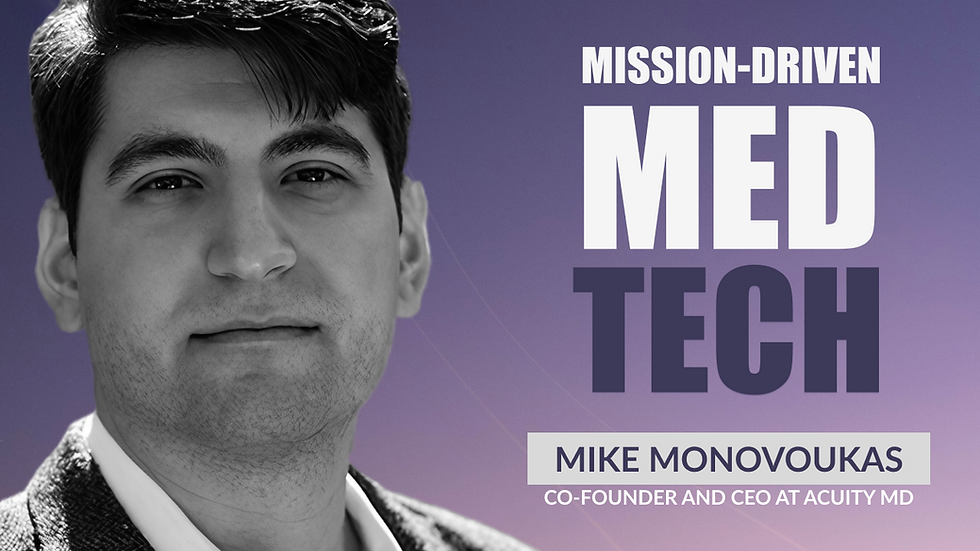
Mike Monovoukas is the co-founder and CEO of Acuity MD, a platform that helps medical device manufacturers find and convert commercial opportunities by combining publicly available market data with companies' internal commercial data. Mike studied International Affairs and Public Policy at Princeton, holds an MBA from Harvard, started his career in management consulting at Bain, and before Acuity MD co-founded a medical device startup with his brother. That first startup didn't make it. But the problem he kept running into while trying to sell it became the foundation for the company he runs now.
What's distinctive about Mike isn't the platform. It's how he frames why it exists. Acuity MD only does well when innovative medical technologies actually reach the patients who need them. That alignment isn't a value statement — it's the physics of how the company makes money. And it shapes who Mike hires, which customers he walks away from, and how he thinks about what regulators can do to unlock more innovation.
Here's what we got into.
[00:05:08] The wound stylus, and what Mike learned from a failure
Mike's first medical device, built with his brother, was a wound stylus — the optical chip from a computer mouse mounted on a pen, designed to let clinicians measure wound area and perimeter by tracing on the skin. This was before 3D imaging came to the iPhone. The startup didn't make it. But the experience taught Mike something specific about what was missing in the industry he'd just tried to break into:
"There's all this data that's out there that can help lower the bar. It can help ramp people faster into those very nuanced and specific clinical areas that will allow them and afford them that opportunity to ask better questions and build closer relationships with end customers."
He was talking about the hours he was spending before every sales call — researching surgeons, where they trained, who they trained under, what they published, what procedures they performed. The data existed. Nobody had assembled it.
[00:06:28] The aha moment
The insight wasn't the public data alone. It was that combining publicly available market data with a company's own commercial data — sales records, contract information, pricing, territory data — surfaced opportunities neither dataset showed in isolation. Public data tells you who the surgeons are and what they do. Internal data tells you which of them you've already touched and how. The intersection is where the actionable opportunities live, and most of them have been there all along.
[00:13:30] The surfing bet
Acuity MD started at the end of 2019. COVID hit a quarter later. The three co-founders took a surfing lesson together, and the bet was: whoever lost would spend the night manually researching physicians' fellowship and residency backgrounds for a customer who needed to map training networks in a specialty area.
Mike lost. He spent the evening doing manual research on fellowship trees because the customer needed to see who had trained under whom — because medical knowledge passes down through training programs, and adoption follows the same lines. That was the unscalable work that made the customer real. It's a Paul Graham story. It's also still how Acuity MD's data layer got built.
[00:20:04] Missionaries, not mercenaries
This is where Mike drew the line that stayed with me.
"There's an oddly clarifying state where the mission of the company also is kind of the product roadmap in a sentence."
The mission isn't a separate document that occasionally references the product. It is the product. Accelerate the adoption of medical technology — that's the company in one line. And that filter determines hiring:
"We hire mission-driven people at Acuity MD. We test for that in the interview process. Hiring missionaries, not mercenaries."
[00:21:04] The physics of the business model
The framing is unusual. Most founders talk about mission and business model as if they're separate concerns — one is the why, the other is the how. Mike's argument is that the physics of the business model can quietly work against the mission no matter how compelling the language. Acuity MD only does well when its customers' innovative technologies gain adoption — when more patients get treated, more devices get used, more surgeries happen with better tools.
The opposite of that, in Mike's framing, is a healthcare business designed to make money by restricting care:
"If you really peel back the kind of physics of their business model, they're really designed to restrict access to care."
He flagged this carefully, knowing it's a loaded thing to say. The point isn't that every cost-management business is bad — it's that capitalism finds the seams in any incentive structure. If your business model rewards friction, friction is what scales.
He singled out prior authorization, increasingly automated by AI:
"You can apply AI, you can apply a number of different technologies in the prior auth process… but at the end of the day, you're creating bottlenecks to care, to reduce costs."
[00:25:32] MAUDE, regulators, and transparency
The first prototype of Acuity MD pulled competitive intelligence from FDA's MAUDE database — the catalog of adverse event reports for medical devices. It wasn't the most useful cut of data for sales reps in 2019, partly because the database is enormous and largely unstructured free text. But the bet on regulator-provided data was right. With LLMs now able to query unstructured data with more precision, Mike thinks MAUDE will become a much more useful layer — for product development as much as for sales.
His broader argument about regulators landed at the very end of the conversation:
"Regulators have such a powerful position where they can drive transparency in all sorts of different processes… the first step of improvement is like quantifying the current state, and that comes with accessible data."
And the line founders almost never say:
"We wouldn't have a company if things like the Sunshine Act or CMS or FDA weren't readily sharing information."
[00:30:52] The rural hospital that never gets the memo
This is the story Mike keeps coming back to when he describes what Acuity MD is actually for.
Early in the company's history, during COVID, Acuity MD rolled out to a sales organization for a biliary stenting product. One rep had been working a large rural territory for 15 years. He'd visited every center on his list. Knew every surgeon by name. The platform surfaced his top opportunity as a surgeon at a community hospital on the border of a reservation — a hospital he'd never set foot in.
The rep didn't believe it. He drove out the next week. Not only did the hospital exist, the surgeon was performing high volumes of liver surgery on really sick patients, using outdated and more expensive technology than what the rep was selling. The rep closed a six-figure opportunity. The hospital saved money. The patients got access to better technology.
Every part of Mike's framing of the business — physics, mission, alignment, abundance — collapses into that one moment. The geography of medical device adoption is uneven. The memo doesn't reach everywhere. Acuity MD is in the business of making sure it does.
[00:38:52] Making healthcare abundant
The mission statement is "making healthcare abundant." Mike said it without the slight grimace founders sometimes have when reciting their company's published mission:
"My goal with Acuity MD and our mission is to make healthcare abundant. Our profit motive and our incentive is to have there be more surgeries and more medical devices and higher use of innovative medical technologies."
He acknowledged the trade-off honestly. Pressure on the healthcare ecosystem — value-based care, compliance, utilization management — exists for legitimate reasons. But the unintended consequence is that access to high-quality care gets restricted for someone:
"That rural hospital on the border of a reservation, treating really sick patients, just never gets the memo, never gets noticed, and doesn't have access to great medical technology."
His worry isn't bad actors. It's structural blindness. The places no business model is targeting are the places no business model is reaching.
[00:45:08] Culture is how people make decisions when you're not in the room
The hardest thing right now isn't product or distribution. It's culture. Acuity MD is growing fast, and Mike spent a lot of the conversation circling back to how to keep mission intensity intact at scale. He told a story about hearing the HubSpot CEO Brian Halligan describe culture this way:
"Culture is how people make decisions when you're not in the room."
That's the asset Mike is most focused on protecting. Which is why hiring missionaries, not mercenaries, isn't a slogan — it's the only way the mission survives the company getting bigger.
[00:46:24] The spidey sense
One last thing from the rapid-fire round:
"If you have like a spidey sense that there's something off about any part of the business, you're probably right."
The hardest lesson Mike says he's learned. Hire great leaders. Give them leverage. But the spidey sense isn't delegable. The founders who lose it, he says, are the ones who silo themselves as the company scales.
Listen to the full episode: [episode link] This content was created with AI assistance from the full episode transcript.


